← Guides · 日本語 · Português · 中文
On this page
- The one rule behind all of it
- The recipe catalog
- Incidents & production health
- Scheduled hygiene (the highest-ROI page in the docs)
- Code quality
- Migrations & feature work
- Project management & data
- Getting better at Devin itself ("Devin Optimization")
- How to use this cookbook
- Walkthrough — one recipe run for real, on Devin CLI v3000.14 (swe-2-flash-medium)
- Verify it
- Pitfalls
- Knowledge check
- Sources
Guide 13 — The official use-case cookbook
Goal: the proven usage patterns from Cognition's own docs, organized as a cookbook — what to slice for Devin, and 40+ documented recipes with prompts to copy. Level: start here for breadth Sources: Best Practices · Use-case gallery · use-case tutorials
The one rule behind all of it#
Official guidance, verbatim logic: pick work that is wide & shallow — a large backlog of simple, horizontally-scalable tasks beats complex net-new builds, every time.
| Ideal task | Anti-task |
|---|---|
| Repetitive subtasks at junior-engineer complexity | Net-new complex features |
| < 90 minutes of manual work per slice | Anything unsplittable |
| Objective pass/fail verification | "Looks right to me" |
| Isolated, backwards-compatible, parallelizable | Tangled dependencies |
Four great slice shapes from the docs: migrations, refactors, modernizations, tech-debt backlogs.
The recipe catalog#
Everything below is a documented use case in the official gallery — each ships with a copy-paste prompt. Organized by the job it removes from a human's week.
Incidents & production health#
| Recipe | Mechanism |
|---|---|
| Auto-investigate Datadog/PagerDuty alerts | Webhook/API trigger → session investigates on fire |
| Auto-generate postmortems | PagerDuty resolve → Devin drafts timeline, root cause, action items |
| Daily Sentry error fixes | Nightly cron pulls new errors → fix PRs by morning |
| Debug a bug report end-to-end | Hand Devin the report + Datadog logs + DB access → root cause |
Scheduled hygiene (the highest-ROI page in the docs)#
| Recipe | Cadence |
|---|---|
| Weekly dependency update PRs | Weekly: outdated packages → tested upgrade PRs |
| Nightly E2E on staging | Nightly: run suite, file tickets for failures |
| Weekly changelog from merged PRs | Friday: categorized changelog → Slack |
| Daily Datadog health digest | Daily: error scan → Slack digest |
| Daily design-system audit | Daily: flag hardcoded colors/missing tokens in merged PRs |
| Feature-flag cleanup | One-time session strips flag + dead code post-release |
| Weekly Notion status digest | Weekly: PR/commit summary → Notion |
| PRs from meeting transcripts | Hourly: poll Granola → extract eng tasks → child sessions |
Code quality#
| Recipe | Mechanism |
|---|---|
| Auto-fix PR bugs before merge | Devin reviews every PR, pushes fixes to the branch |
| Add unit tests to a service | Build a test-writing skill, apply to charge flows/refunds/webhooks |
| Catch visual regressions | Repo skill: screenshot every affected page before PR |
| Migration checklist on every PR | Repo skill catches destructive ops, validates schema changes |
| Split a monolithic router | 2,000-line Express router → domain routes with shared middleware |
| Raise code coverage | Devin analyzes the suite, writes tests to cover gaps |
| Patch known CVEs across repos | Official skills (devin-vuln-fixes): read-only inventory → approval gate → confirmed-target patch → before/after tests → one PR per repo |
Migrations & feature work#
| Recipe | Mechanism |
|---|---|
| 50-file REST→GraphQL | Scope → conflict-free packages → parallel (Guide 11) |
| React 18→19 upgrade skill | Turn the official upgrade guide into a phased skill for your codebase |
| OpenAPI spec → implementation | YAML spec → Express handlers + Zod validation + Supertest |
| Stripe checkout flow | Spec → working flow + tests + browser verification |
| i18n a Next.js app | next-i18next install, string extraction, 3-language browser check |
| Figma → pixel-perfect | Figma MCP → components from mockups |
| Dockerize a Django app | Multi-stage Dockerfile + compose for Django/Postgres/Redis |
Project management & data#
| Recipe | Mechanism |
|---|---|
| Auto-triage bugs via Linear | Label applied → Devin investigates |
| PRDs → sprint tickets | Notion PRD → scoped Linear tickets |
| Backlog implementation plans | Multi-select Linear tickets → confidence-scored plans |
/dana data queries in Slack |
Plain-English database queries from any channel |
| Custom API usage dashboard | Devin builds a tailored dashboard on the v3 API |
Getting better at Devin itself ("Devin Optimization")#
| Recipe | Lesson |
|---|---|
| Cut a feature prompt 42→12 ACUs | Autopsy a costly session: 3 root causes → rewrite the prompt |
| Race 3 sessions on one problem | Parallel sessions try competing optimization strategies; best ships |
| 8 parallel sessions overnight | 8 untested modules → unit-test PRs by morning |
| Evaluate 30 libraries | One session per library → scored, ranked comparison |
| Turn a hotfix into a skill | Extract a successful incident session into a reusable skill |
| Weekly knowledge dedup | Scheduled session merges/conflicts-cleans knowledge suggestions |
| Team onboarding guide | Devin reads its own docs → a getting-started guide for your stack |
How to use this cookbook#
- Pick one recipe from Scheduled hygiene — it's the cheapest first win (a nightly/weekly loop you stop thinking about)
- Add one from Incidents if you have PagerDuty/Datadog/Sentry
- When a recipe works, freeze it as a skill (Guide 12) or a Bot (Guides 1–5) — every row above survives as either
Walkthrough — one recipe run for real, on Devin CLI v3000.14 (swe-2-flash-medium)#
The Raise code coverage recipe from the Code quality shelf, run end-to-end on a small repo with a deliberately under-tested orders.py (discount codes, shipping tiers, edge cases). A one-line prompt; Devin did the rest.
Video (74 s, silent): recipe prompt → reads → test-writing edit → command approval → all green.
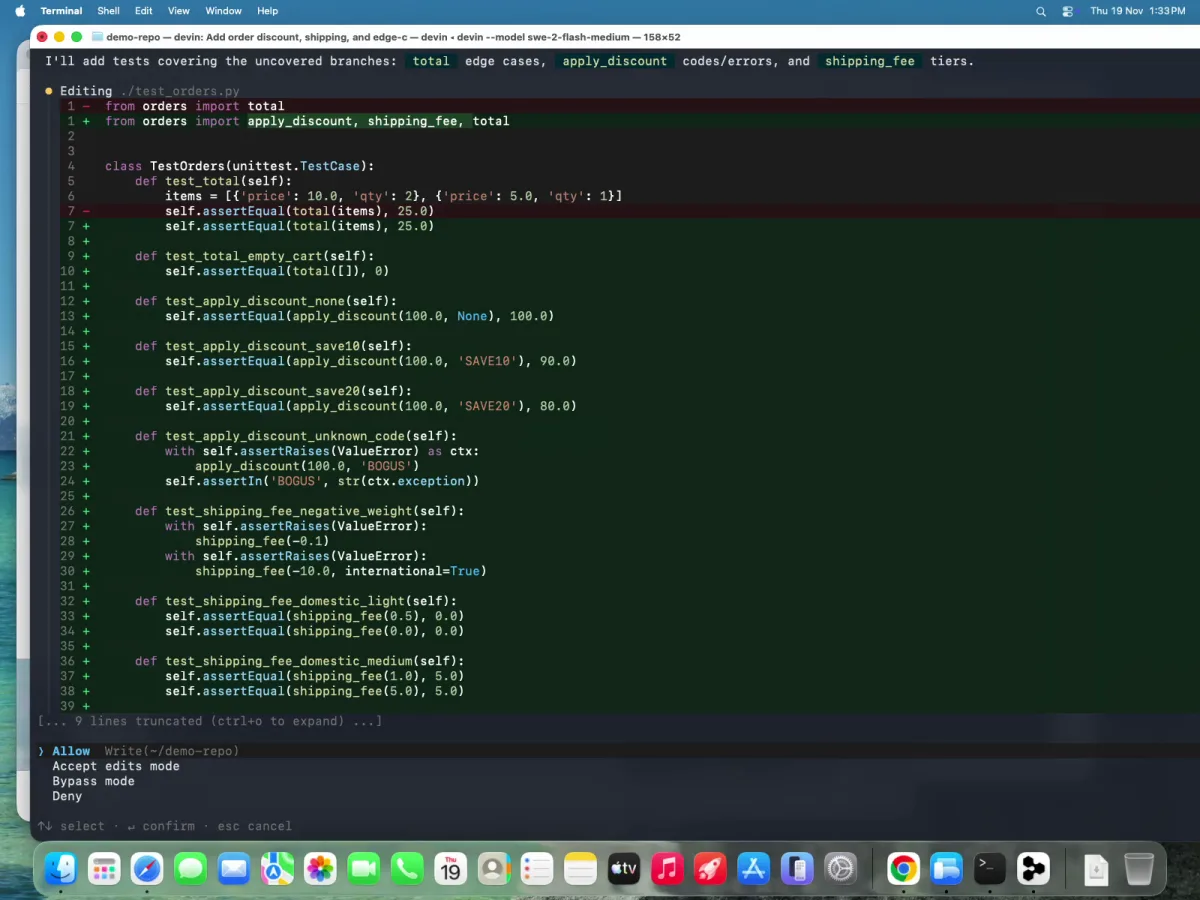
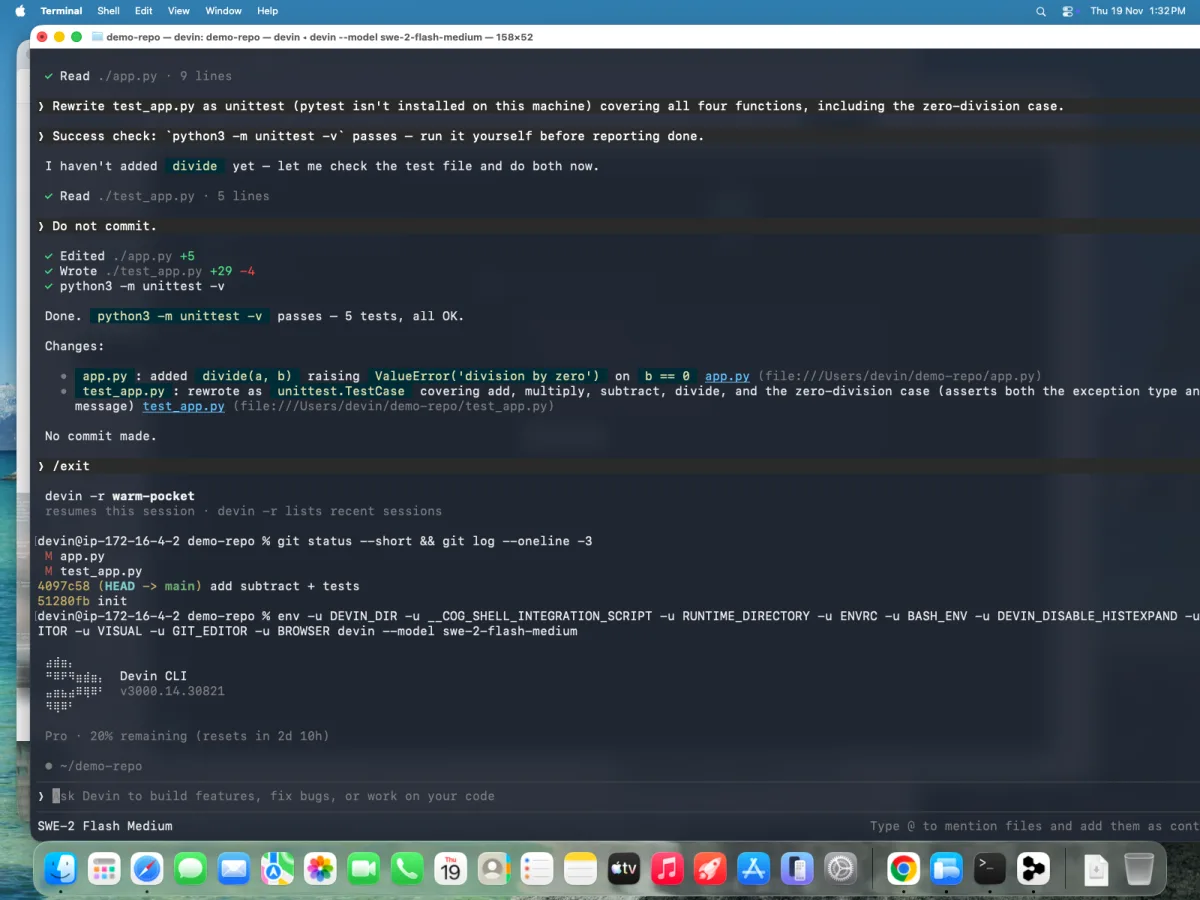 1. The CLI REPL on swe-2-flash-medium — free tier on a Pro plan
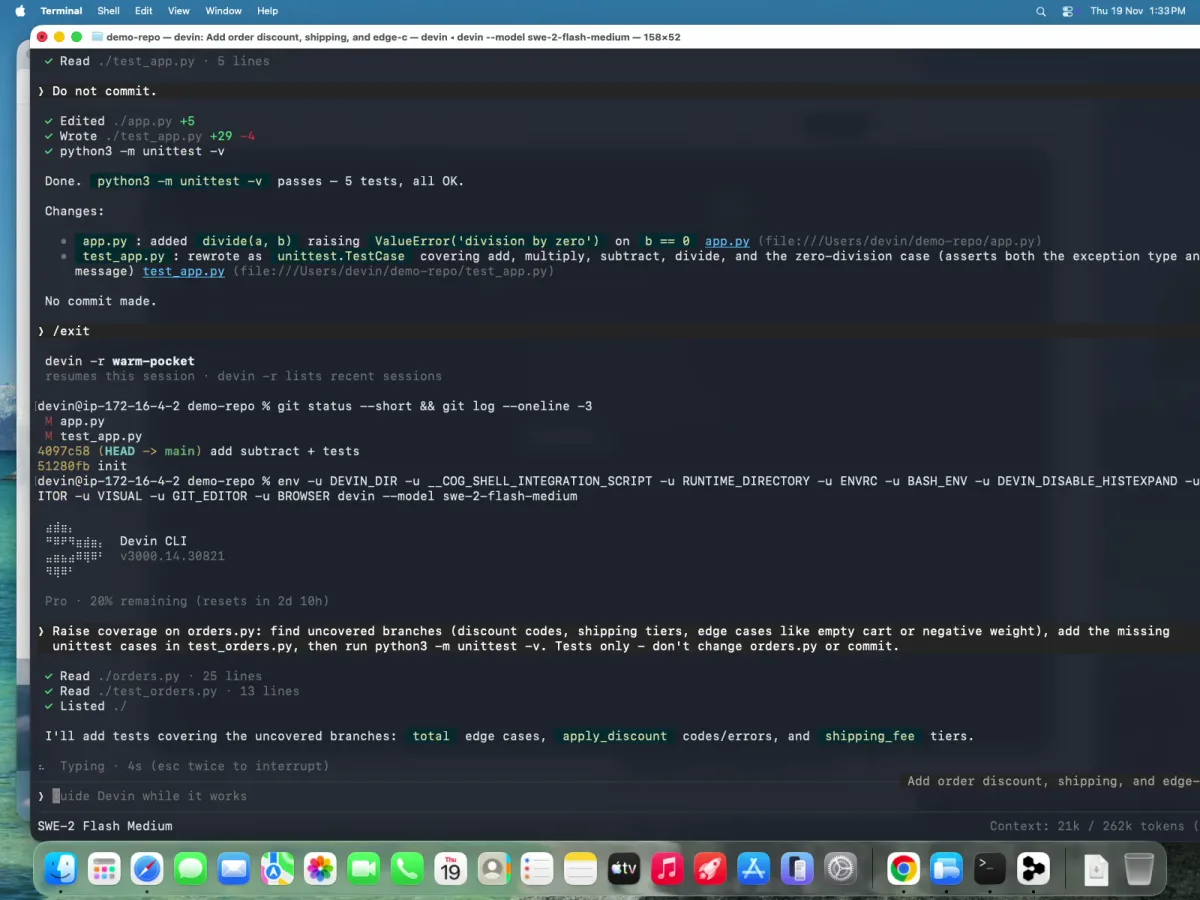 2. The recipe prompt submitted — Devin reads orders.py and test_orders.py first
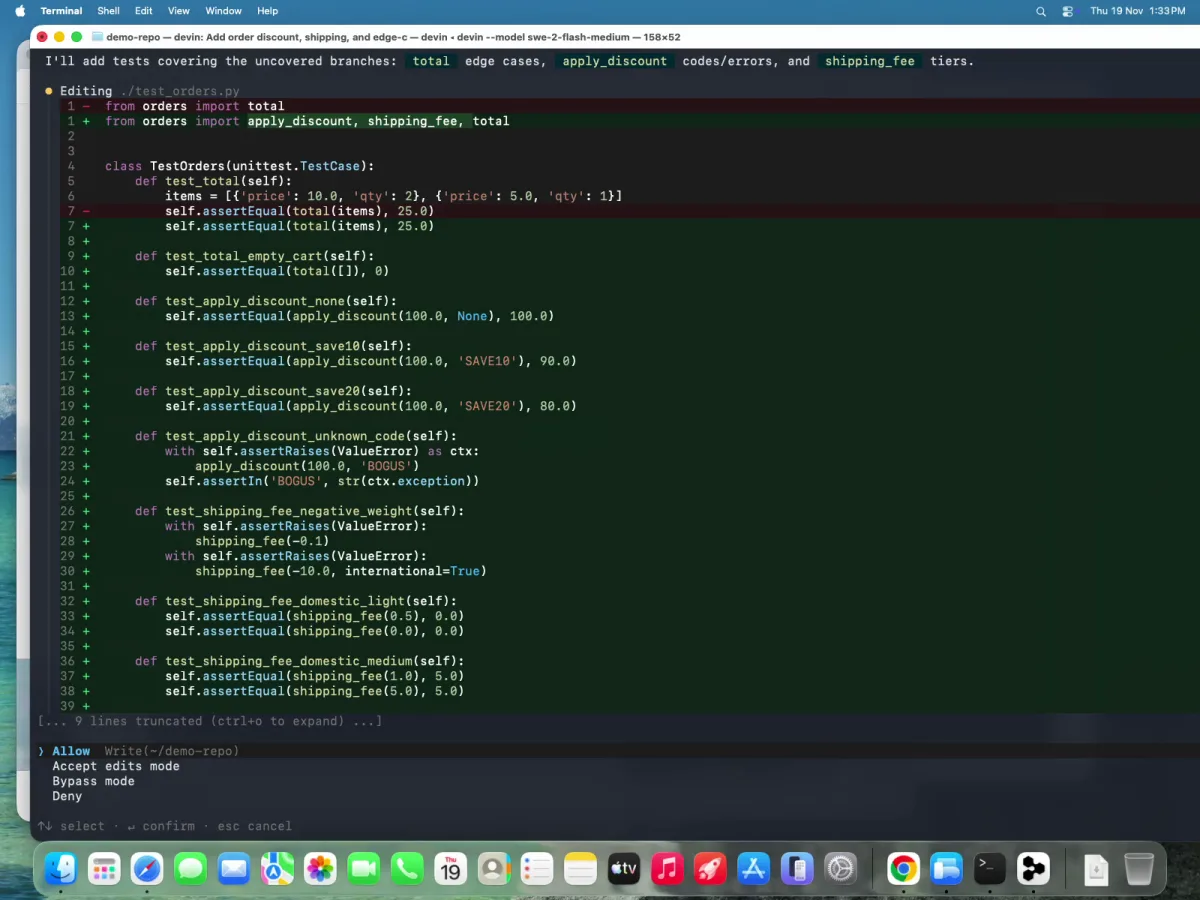 3. Writing tests — +43 lines covering empty cart, discount codes, and every shipping tier
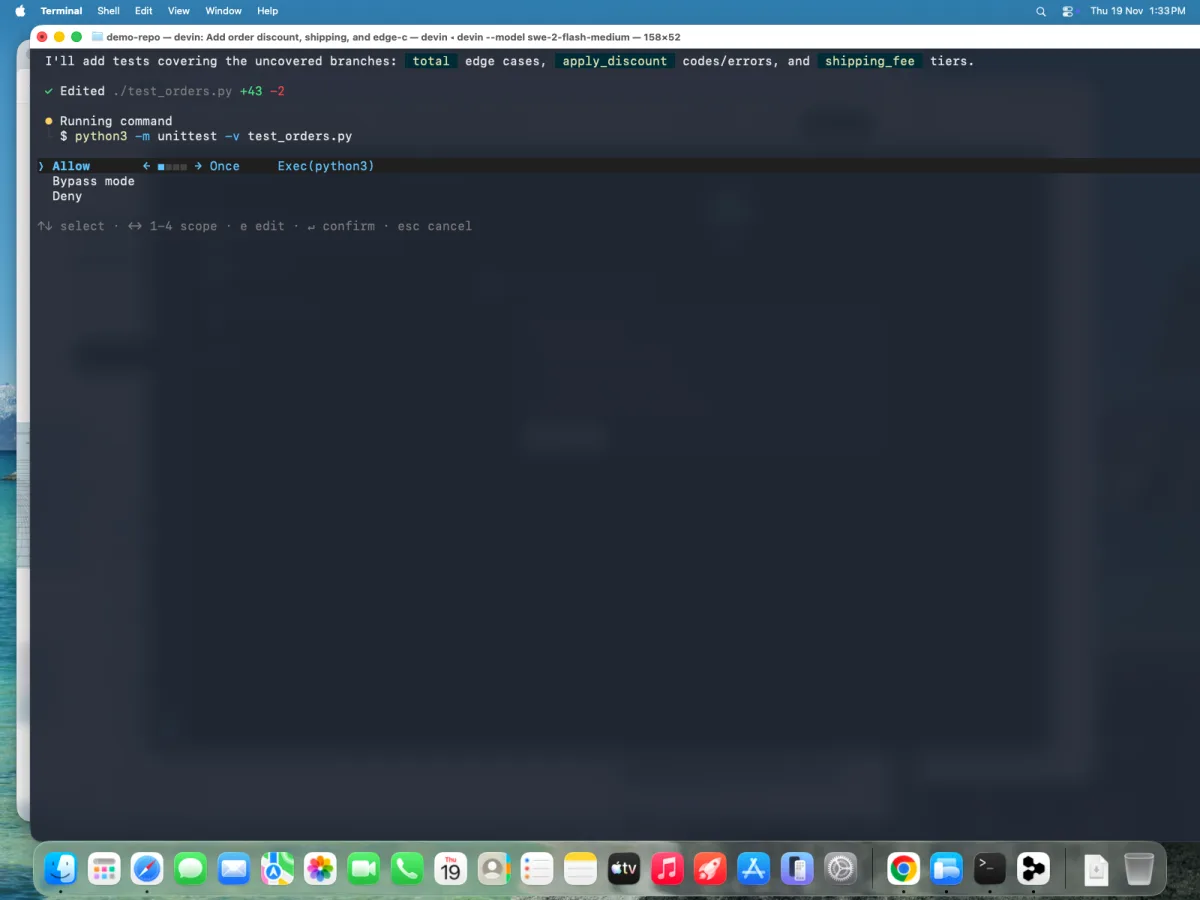 4. Command approval —
python3 -m unittest -v test_orders.py waits for an Allow
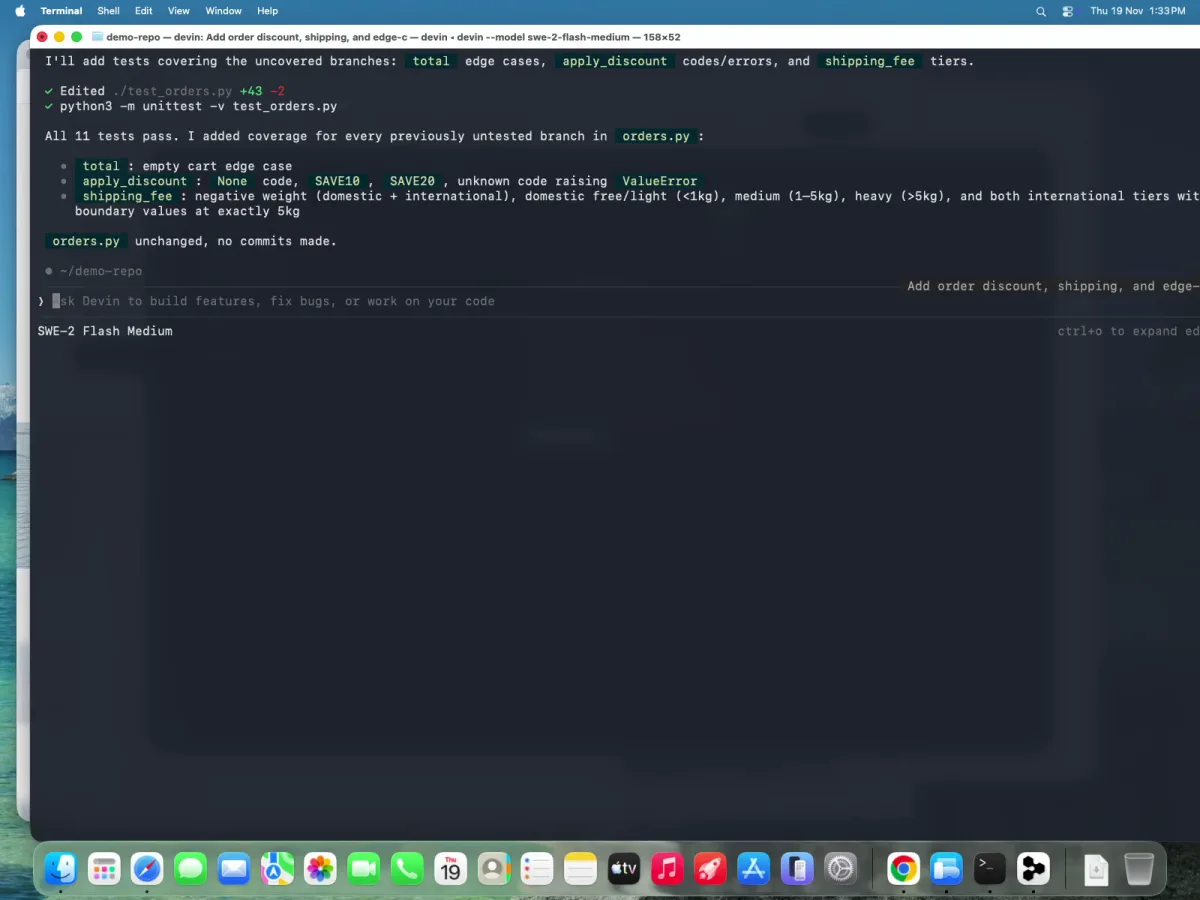 5. All 11 tests pass — every previously untested branch named; orders.py untouched, no commits
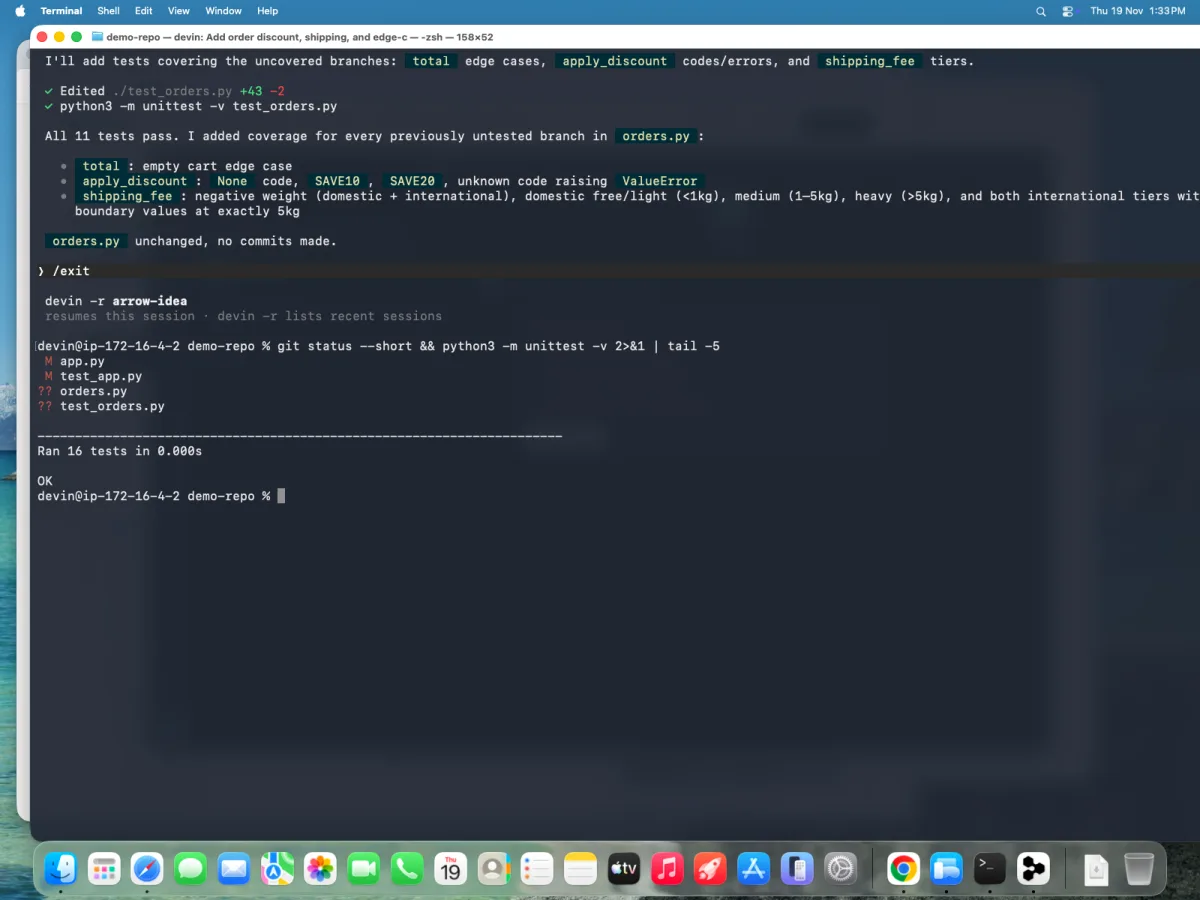 6. Verified after /exit —
Ran 16 tests ... OK, changes stay uncommitted as instructed
Verify it#
- [ ] One hygiene recipe is running on a schedule and produced its first PR/report
- [ ] Its output is frozen as a skill, playbook, or Bot — not living in someone's head
Pitfalls#
- Ten recipes, zero frozen. A recipe that stays a manual prompt is forgotten by Friday — operationalize or drop it.
- Copy-paste prompts without your repo's verification. The gallery prompts assume a test suite exists; adapt the check, not just the task.
Knowledge check#
- Why start with a scheduled-hygiene recipe rather than incident response? (Cheapest possible win — it runs while you sleep, and a wrong nightly lint fix is recoverable; a wrong incident action isn't.)
- What does 'freeze a recipe as a skill or Bot' actually prevent? (Prompt drift and single-person dependency — the recipe survives the person who wrote it.)
- Why adapt the verification part of a gallery prompt before the task part? (The task describes intent; the check is what your repo can actually prove — wrong checks produce confident garbage.)
Sources#
- Use-case gallery — all recipes above, each with copy-paste prompts
- Best Practices — the slicing doctrine
- Use-case tutorials — API integration, code coverage, containerization, frontend components, MCP
- Related: Guide 11 — Migrations at scale · Guide 6 — Automations