← Guides · 日本語 · Português · 中文
On this page
Guide 18 — Talking to Devin: the prompting doctrine
Goal: Write instructions Devin can't misread — the difference between a session that ships and one that wanders. Level: Start here Sources: Coding Agents 101 (Cognition, June 2025) · Instructing Devin Effectively — both official, both distilled below with field notes
Why this guide is first#
Every other guide in this repo assumes one skill: you can tell Devin what you want in a way it can't misread. Cognition's own guidance — Coding Agents 101 and the docs' Instructing Devin Effectively — says the same thing from two angles: the engineers who get the most out of agents write like they're briefing a junior teammate, not like they're filing a wish. This guide is that doctrine, condensed and wired to the rest of the curriculum.
The four rules that carry everything else#
1. Say how, not just what. "Fix the C++ bindings for our search module to pass the new unit tests — be careful, you'll need to recompile the bindings each time before testing." You know the traps in your codebase; name them. Open-ended briefs ("make the app look better", "improve database performance") return open-ended results.
2. Tell it where to start. Repo, directory, file, reference implementation, docs URL — anything you'd want if the task landed on your desk. "Use authTemplate.rs as a reference to maintain consistency in error handling" beats a style paragraph every time.
3. Define success as something checkable. Not "make sure it works" — a check Devin can run: endpoint returns 200 with fields X/Y/Z, component renders with zero console errors at 1440px and 375px, npm test green. Devin has a full machine — browser, shell, IDE. Tell it to verify its own work ("run npm run dev and confirm /settings renders") and it will QA before you ever see the PR.
4. Give it feedback loops, not feedback vibes. Type checkers, linters, tests, CI — the agent's superpower is iterating against error messages. If your repo can't tell it when it's wrong, you're the feedback loop, and that's the expensive configuration.
The reference brief#
Cognition's own model prompt, annotated:
In the Devin repo, build a tool that monitors RAM and CPU usage of the remote machines Devin runs on. — scope and purpose, one line
- Create a background task that launches when devin.rs starts — step-by-step, not a blob
- It opens a connection to all forked remote machines and monitors usage — mechanism named
- If usage exceeds 80%, emit a new type of Devin event (check how we use Kafka) — success criterion + pointer to existing pattern
- Architect so it doesn't block other operations — constraint the author already knows
Notice what's absent: aesthetic opinions, hedging, "maybe", "if you think it's a good idea". Every line is a decision already made by a human who knows the system.
Defense: what to keep for yourself#
The 101 guide is blunt about the limit: expect ~80% time savings on large tickets, not full automation. For anything beyond a few files, plan for multiple feedback cycles. The winning posture is architect reviewing a junior's draft PR — you hold correctness, Devin holds keystrokes.
Practical consequences:
- Scope hard. "Do not merge, deploy, or touch billing without asking me" — write the fence explicitly, don't rely on implied sense.
- Split big work into verifiable sub-tasks — one session per sub-task, each with its own success check (this is also why Guide 11's migration pattern works: hundreds of small PRs, each verifiable).
- Use Skills for the repeatable — anything you'll ask more than twice goes in a
SKILL.md; Devin invokes it automatically (Guide 16).
From instructing to owning#
A session instruction answers "do this task well". A Bot outcome prompt answers "own this area". The doctrine is the same — specificity, boundaries, checkable success — but the object changes from a task to a responsibility. Once you're fluent here, the outcome-prompts reference shows how the same muscles produce the Android Bot's 1,134 PRs.
Walkthrough — recorded on Devin CLI v3000.14 (swe-2-flash-medium)#
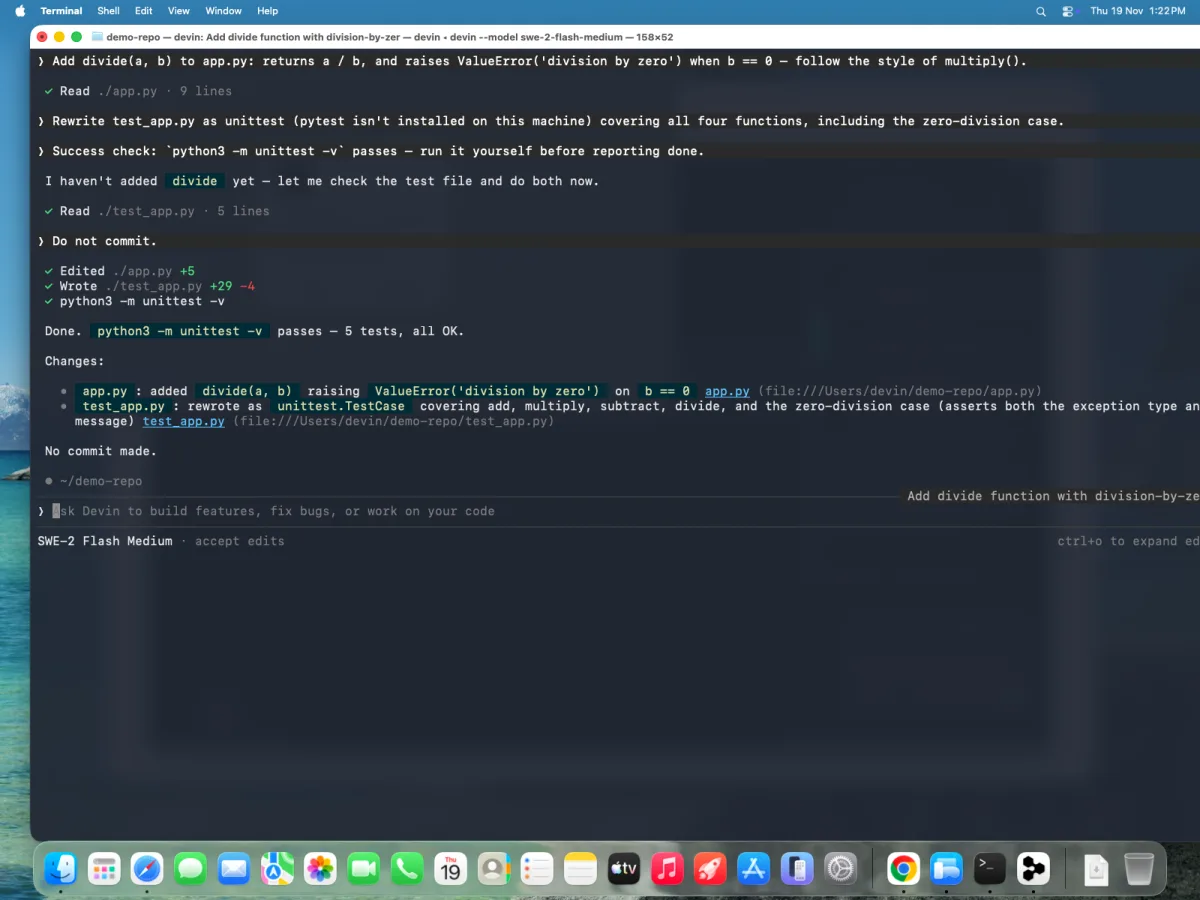
The doctrine run live on a throwaway demo-repo: a four-line brief — scope + mechanism, named files, a checkable success line, an explicit boundary. One session, zero mid-flight clarifications, self-verified.
Video (90 s, no audio): brief → edits → permission prompts → self-check → boundary honored.
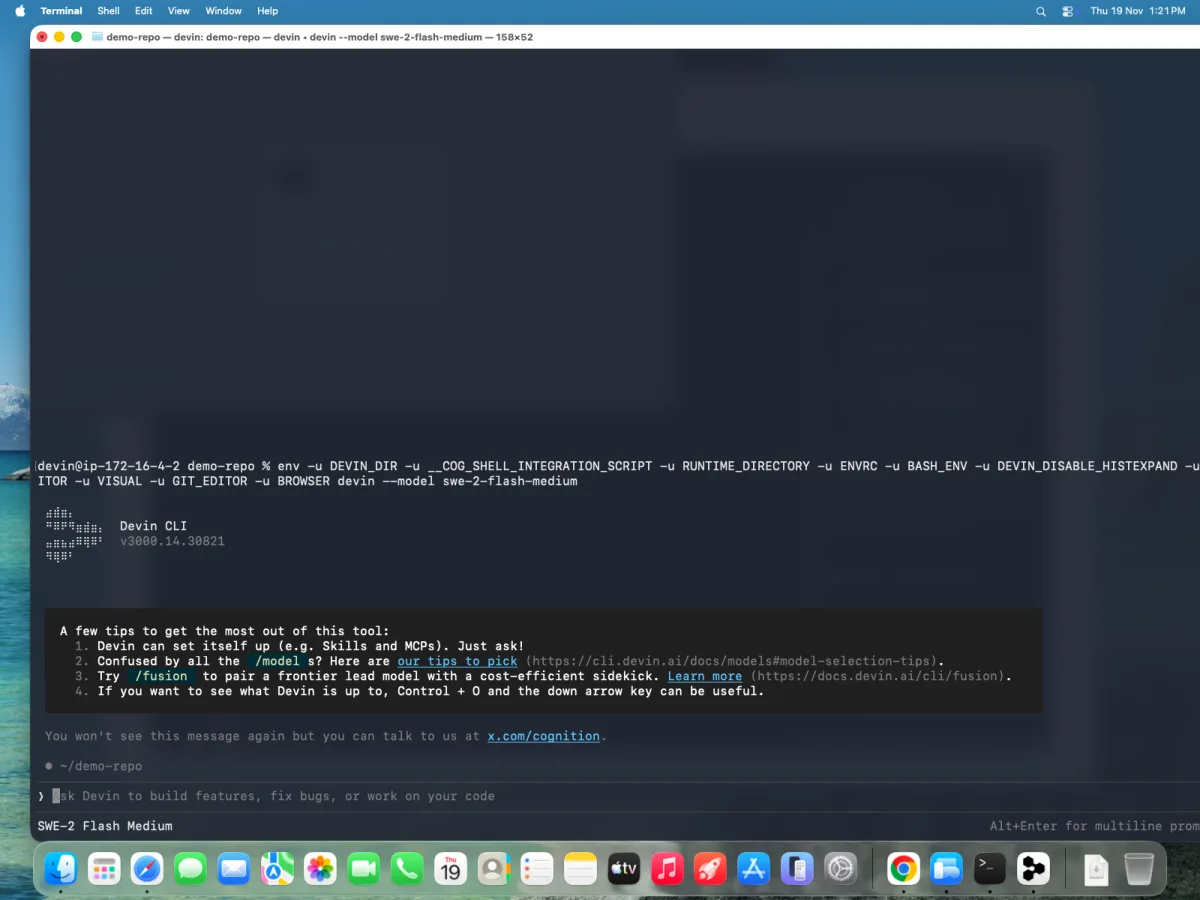 1. The CLI REPL on SWE-2 Flash Medium — composer ready in demo-repo
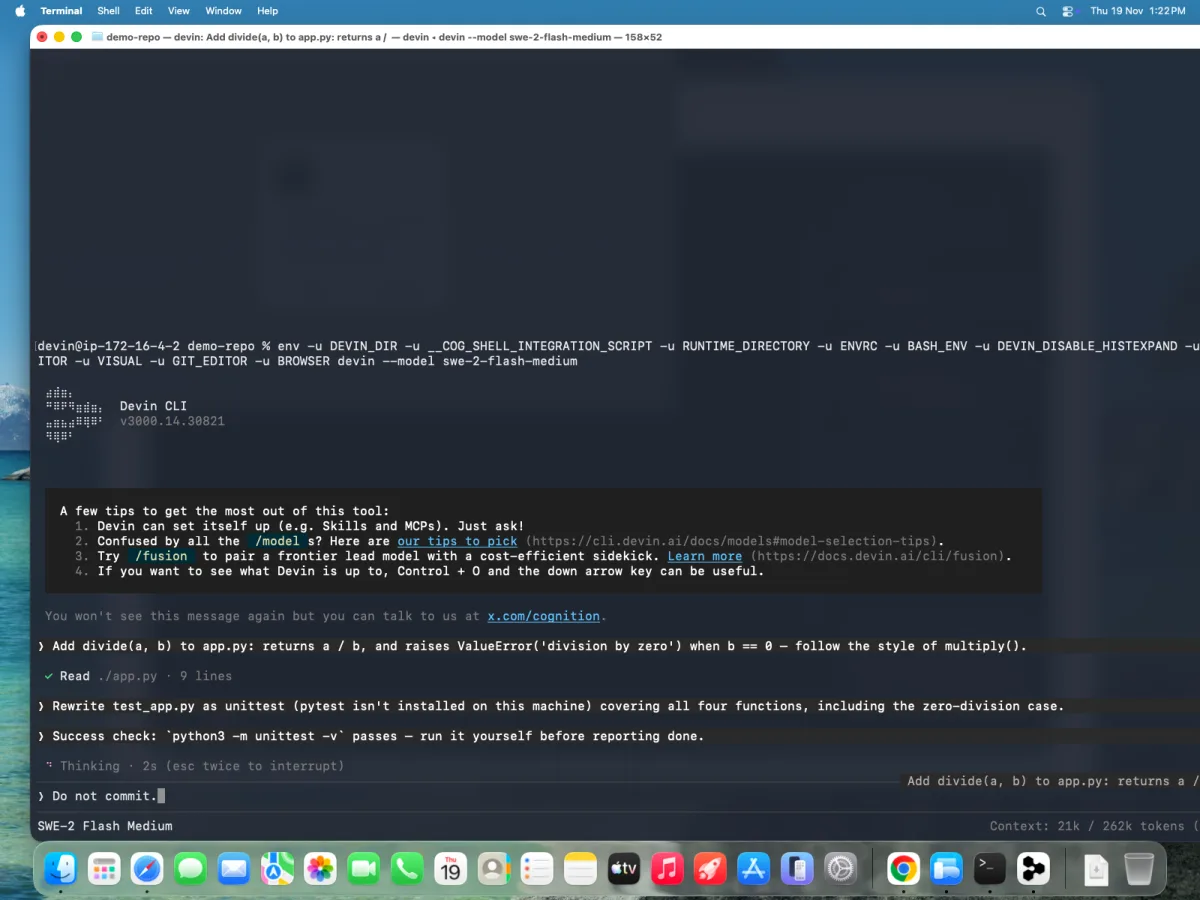 2. The brief — four doctrine rules in four lines: how, where, success check, boundary
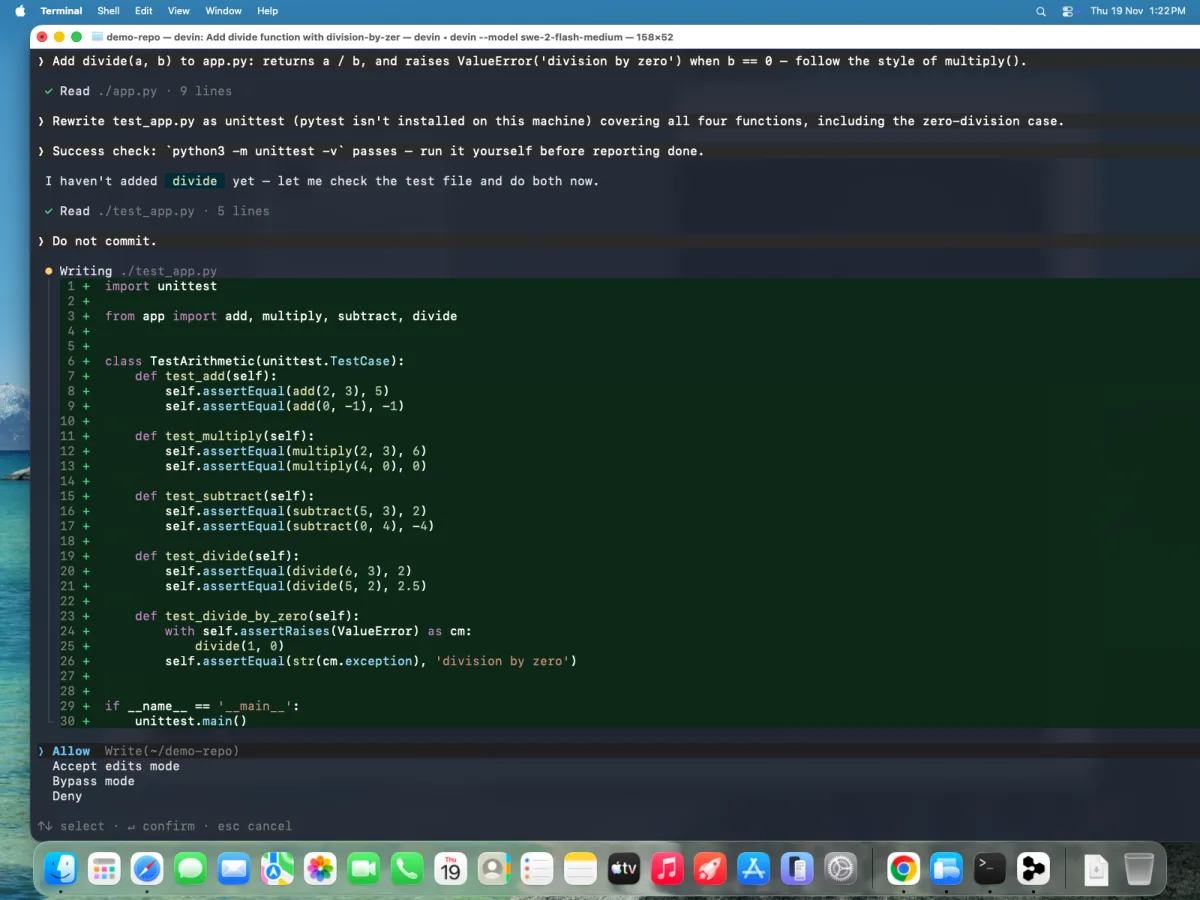 3. Mid-run: writing test_app.py — the permission prompt offers Allow / accept-edits / bypass / deny
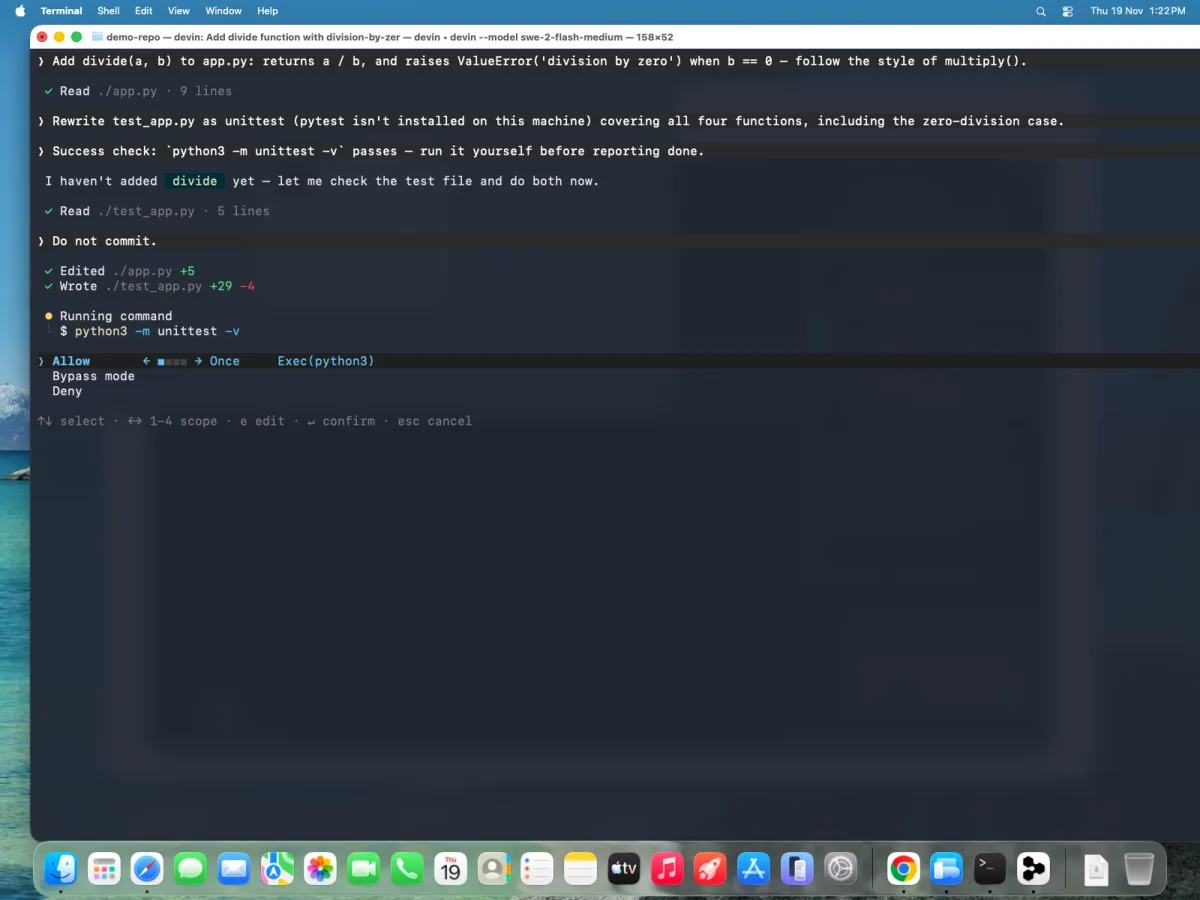 4. Self-verification: the agent requests exactly the named check —
python3 -m unittest -v
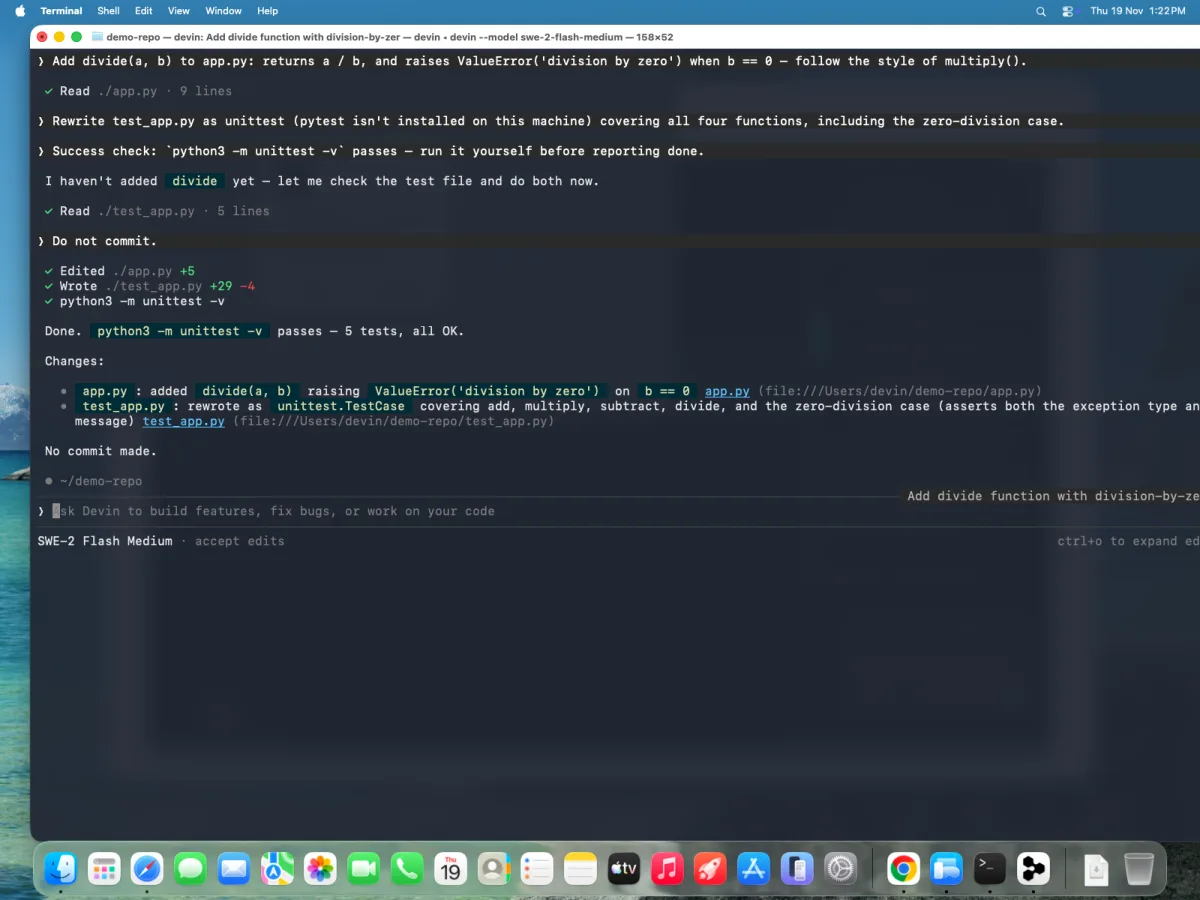 5. Done — 5 tests all OK; the report itself confirms the boundary: "No commit made."
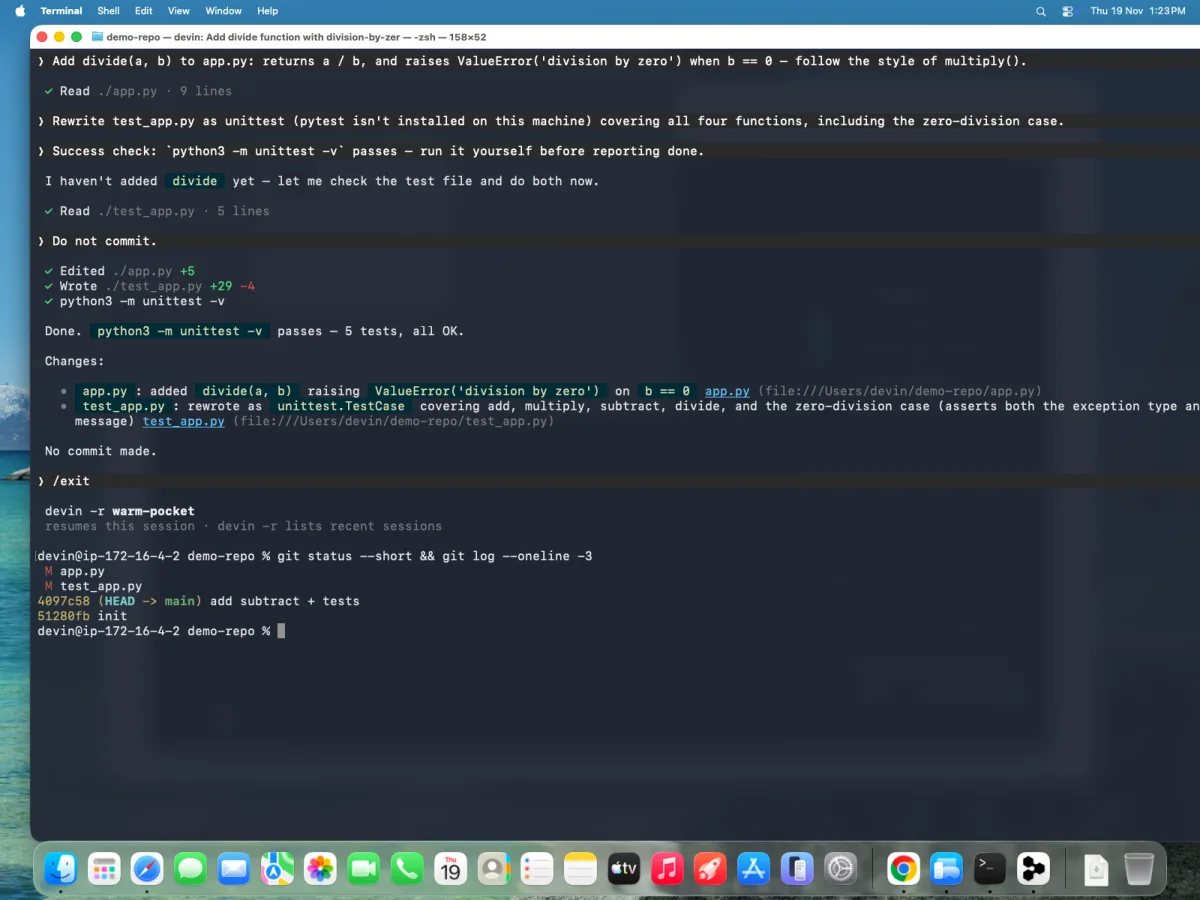 6. After /exit — the
devin -r resume hint, and git status proving the fence held: two modified files, no new commit
Verify it#
- [ ] Given a real task from your backlog, you can write a brief with: named repo/files, a reference pattern, an explicit success check, and a stated boundary — in under 10 minutes.
- [ ] The resulting session completes without a mid-flight clarification you'd call obvious.
- [ ] Devin verifies its own work before the PR — you asked it to in the brief.
Pitfalls#
- Prompts that encode your own confusion. If you can't state the success check, the task isn't ready — co-develop a PRD with Devin first (the 101 guide endorses this) rather than hoping it intuits the goal.
- Under-permissioned ambition. "Fix CI" from an account that can't see CI produces confident wrongness. Match the brief to the access you actually granted.
- Reviewing output, not correctness. A green test run and a plausible diff are evidence of progress, not proof the behavior is right. You still own verification.
Knowledge check#
- "Add unit tests" fails where "add unit tests for the retry path in
poller.ts, mockingfetch, covering timeout and 5xx" succeeds — why? Because the second brief removes the agent's need to make judgment calls you'd want made your way: what to test, which edges matter, what to mock. Every unspecified decision is a coin flip you don't control. - Devin opened a PR with a clean diff and green CI. Done? Not yet — CI green means the checks passed, not that the intent is met. The last verification layer is still yours; that asymmetry is the deal (~80% savings, human on correctness).
- When do instructions graduate to Skills? When you catch yourself re-typing them. A third occurrence is a SKILL.md — Guide 16 covers the format and discovery paths.
Sources#
- Coding Agents 101 — Cognition's prompting doctrine: say-how, where-to-start, defensive prompting, feedback loops, the 80% rule
- Instructing Devin Effectively — the official do/don't list and the reference brief dissected above
- Devin tutorial library + Devin University — official videos and courses if you want the same material in another medium
- Field note: every report in community field reports converges on the same conclusion — briefs, not wishes
- Next: Guide 1 — Your first Bot (same doctrine, bigger object) · Outcome prompts reference